
Silicon in Clinical Practice
Practitioner Education
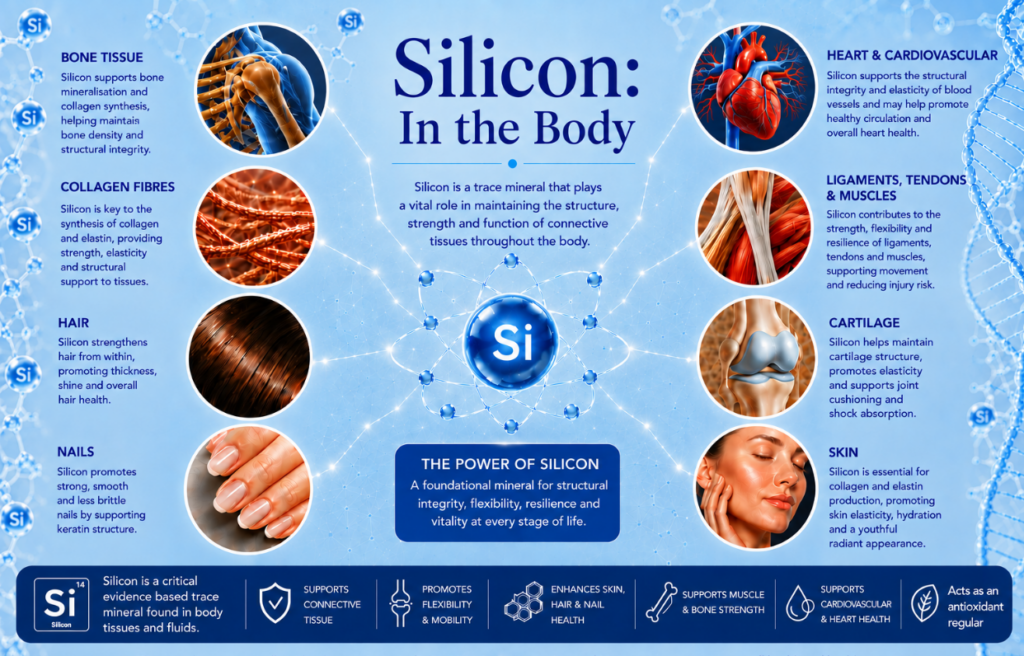
The mineral hiding in the tissues that age first. Almost every clinician reaches for calcium and vitamin D when bone comes up. Far fewer think about the trace element woven into the very tissues that lose their integrity as we age – the skeleton, the arterial wall, the cartilage of a worn knee, the skin. Silicon is one of the most abundant trace elements in the human body, concentrated in connective tissue, where it helps build and cross-link the collagen and glycosaminoglycan scaffold that gives those tissues their strength and elasticity. Its tissue and serum levels fall with age, declining in the aorta and skin precisely as those structures begin to fail. That intersection of biological plausibility and age-related decline is why silicon is worth a place in your thinking, and why a specific group of patients may benefit from looking at it more closely.
An overlooked structural mineral
The adult body contains roughly 1–7 g of silicon, making it among the most abundant trace elements after iron and zinc, concentrated in connective tissue: bone, the aorta and arteries, skin, tendons, hair and nails. It circulates in serum almost entirely as orthosilicic acid, and both serum and tissue silicon decline with age, most steeply beyond the sixth decade and particularly in women,the same group in whom connective-tissue integrity is most often a concern. A point of accuracy worth keeping: silicon is not formally classified as essential in humans. The honest description is a beneficial, bioactive trace element, biologically plausible, with a real and growing evidence base that is strongest in bone.
One mechanism, many tissues
A single mechanism ties its clinical domains together. Silicon is bound within glycosaminoglycans and helps cross-link collagen with proteoglycans, stabilising the extracellular matrix; in human osteoblast-like cells, orthosilicic acid stimulates type I collagen synthesis via the enzyme prolyl hydroxylase. Because that collagen–GAG scaffold underpins bone, arteries, cartilage and skin alike, silicon’s influence shows up across all of them.
What the research shows, by system
Bone is where the human signal is clearest. In the Framingham cohort, higher silicon intake tracked with up to ~10% higher hip bone density in men and pre-menopausal women, and silicon’s effect on bone matrix is largely independent of vitamin D, meaning it cannot be substituted for by vitamin D alone. Beyond bone, the picture is promising and still growing:
- Skin, hair & nails: ch-OSA improved skin elasticity and reduced hair and nail brittleness in a placebo-controlled trial; supportive, though several studies are small.
- Cardiovascular: aortic silicon falls as atherosclerosis advances, and a 2025 randomised trial reported reduced arterial stiffness and systolic blood pressure, but only in subgroups with elevated baseline values, not the whole sample.
- Neuroprotection: aluminium accumulates in Alzheimer’s brain tissue and co-localises with its defining pathological proteins amyloid-beta and tau. Human studies show that silicon reduces aluminium absorption (Edwardson 1993) and increases urinary aluminium excretion (Davenward 2013), limiting aluminium burden, and higher silicon intake has been associated with lower dementia risk.
Why the form is everything
Here is the practical heart of the matter. The body absorbs silicon only as soluble, monomeric orthosilicic acid, but orthosilicic acid is unstable, polymerising above ~100 mg/L into large particles that the gut cannot take up. Diet compounds this: much dietary silicon sits in poorly-absorbed forms, and many soils (Australia’s included) are now low in plant-available silicon.
So the real question for any silicon supplement is not “how many milligrams?” but “in what form, and how efficiently is it delivered?” The forms differ sharply on both counts:
| Silicon form | Absorption | Formulation & practical note |
|---|---|---|
| Standard silica (colloidal / precipitated SiO₂) | Poorly absorbed (~1%); largely excreted | The most common form in food and supplements, and a common excipient. A weak silicon source despite an impressive label number. |
| Stabilised orthosilicic acid (ch-OSA / M-OSA) | Moderate (~17–30% reported) | Stabilisers (choline, maltodextrin) hold orthosilicic acid in solution and prevent polymerisation. This is the form behind most human trial data. Typically a liquid. |
| Monomethylsilanetriol (MMST) | A single acute study reported ~64% absorption for the liquid only – not solid products | That headline figure is one acute measurement of a liquid. As a solid/powder, MMST must be carried on bulking agents and gums, so a typical powder delivers only ~10 mg of elemental silicon per gram (about 1% active), the rest being carrier and excipient. |
| Mesoporous bioactivated silica | High; absorbed along the whole intestinal tract (mainly the ileum) by passive diffusion | An engineered porous solid, importantly micron-sized, not nanoparticulate, that releases monomeric orthosilicic acid and resists polymerisation, delivering a high silicon load in a compact solid without the heavy carrier burden a solid MMST powder requires. |
What to look for in a supplement’s silicon form
Based on the absorption research above, an effective oral silicon supplement should:
- Deliver silicon as monomeric orthosilicic acid, or from a form that reliably releases it
- Resist polymerisation before ingestion, stability in the product matters
- Provide elemental silicon in the 10–30 mg/day range studied in clinical trials
- Avoid heavy excipient or carrier loads that dilute active content
Not all products meeting these criteria are identical, but any product that does not meet them is unlikely to produce the results discussed in this newsletter.
Dosing and safety
Human studies have used roughly 3–86 mg of silicon per day; common supplemental intakes sit around 10–30 mg/day (elemental). Water-soluble silicon is rapidly excreted by the kidneys, with no oral toxicity demonstrated even at high intakes, and no clinically significant drug interactions established.
Who to consider it for
Reach for silicon in these patients:
- Bone-density patients with an incomplete response: osteopenia or osteoporosis not improving on calcium and vitamin D alone (most supported in men and pre-menopausal women).
- Connective-tissue, skin, hair & nail concerns: brittle nails, fragile or thinning hair, ageing or photo-damaged skin with reduced elasticity, and tendon, ligament or cartilage complaints.
- Cardiovascular ageing: older patients with early arterial stiffening or high-normal blood pressure (supportive, not a treatment for hypertension).
- Higher aluminium burden: occupational exposure, chronic antacid use, or an interest in reducing aluminium load.
- Older adults and those with poor dietary silicon: low whole-grain intake, reliance on refined foods, or simply age-related decline.
In clinic: choosing a silicon product
- Does this deliver monomeric orthosilicic acid, or a form that reliably releases it?
- Is it stable against polymerisation before ingestion?
- What is the elemental silicon per dose, not just the compound weight?
- Does the evidence for a particular outcome (bone, skin, cardiovascular) come from this form, or a different one?
These questions separate effective forms from inert ones.
The bottom line
Silicon is the connective-tissue mineral most of us overlook. Low-risk, mechanistically coherent, and genuinely useful for the right patient. Its evidence is strongest in bone, with promising signals across skin, joints and vascular ageing.
But one fact should govern every recommendation: the form is the therapy.
Poorly-absorbed silicon, the standard silica in most supplements, largely passes through without being absorbed. In many powders, much of that weight is carrier rather than absorbable mineral, so a high label number doesn’t always mean more usable silicon. What matters is delivering soluble, monomeric silicon the tissues can actually use.
Match the patient to the evidence, and the form to the outcome. Silicon stops being an afterthought and becomes a tool worth reaching for.
Selected references
- Virsolvy A, Benmira AM, Allal S, et al. Benefits of dietary supplementation with specific silicon-enriched spirulina on arterial function in healthy elderly individuals: a randomized, placebo-controlled trial. Nutrients. 2025;17(5):864. (The strongest recent human RCT; demonstrated reduced arterial stiffness and blood pressure in subgroups with elevated baseline values.)
- Nielsen FH. Update on the possible nutritional importance of silicon. J Trace Elem Med Biol. 2014;28(4):379–382.
- Price CT, Koval KJ, Langford JR. Silicon: a review of its potential role in the prevention and treatment of postmenopausal osteoporosis. Int J Endocrinol. 2013;2013:316783.
- Jugdaohsingh R, Tucker KL, Qiao N, et al. Dietary silicon intake is positively associated with bone mineral density in men and premenopausal women of the Framingham Offspring cohort. J Bone Miner Res. 2004;19(2):297–307.
- Reffitt DM, Ogston N, Jugdaohsingh R, et al. Orthosilicic acid stimulates collagen type 1 synthesis and osteoblastic differentiation in human osteoblast-like cells in vitro. Bone. 2003;32(2):127–135.
- Carlisle EM. Silicon: a requirement in bone formation independent of vitamin D1. Calcif Tissue Int. 1981;33(1):27–34.
- Barel A, Calomme M, Timchenko A, et al. Effect of oral intake of choline-stabilized orthosilicic acid on skin, nails and hair in women with photodamaged skin. Arch Dermatol Res. 2005;297(4):147–153.
- Sripanyakorn S, Jugdaohsingh R, Dissayabutr W, et al. The comparative absorption of silicon from different foods and food supplements. Br J Nutr. 2009;102(6):825–834.
- Dudek Ł, Kochman W, Dziedzic E. Silicon in prevention of atherosclerosis and other age-related diseases. Front Cardiovasc Med. 2024;11:1370536.
- Edwardson JA, Moore PB, Ferrier IN, et al. Effect of silicon on gastrointestinal absorption of aluminium. Lancet. 1993;342(8865):211–212.(Human study demonstrating silicon reduces aluminium absorption.)
- Davenward S, Bentham P, Wright J, et al. Silicon-rich mineral water as a non-invasive test of the “aluminium hypothesis” in Alzheimer’s disease. J Alzheimers Dis. 2013;33(2):423–430. (Clinical trial showing silicon-rich water increases urinary aluminium excretion.)
- Exley C, Clarkson E. Aluminium in human brain tissue from donors without neurodegenerative disease: a comparison with Alzheimer’s disease, multiple sclerosis and autism. Sci Rep. 2020;10:7770.
- Mold MJ, Linhart C, Gómez-Ramírez J, et al. Aluminum and amyloid-β in familial Alzheimer’s disease. J Alzheimers Dis. 2020;73(4):1627–1635.
- Mold MJ, O’Farrell A, Morris B, Exley C. Aluminum and tau in neurofibrillary tangles in familial Alzheimer’s disease. J Alzheimers Dis Rep. 2021;5(1):283–294.
Educational summary for healthcare professionals. This material discusses the physiology and research on silicon; it is not a product claim and is not a substitute for clinical judgement. Always read the label and use only as directed.

No Comments
Sorry, the comment form is closed at this time.